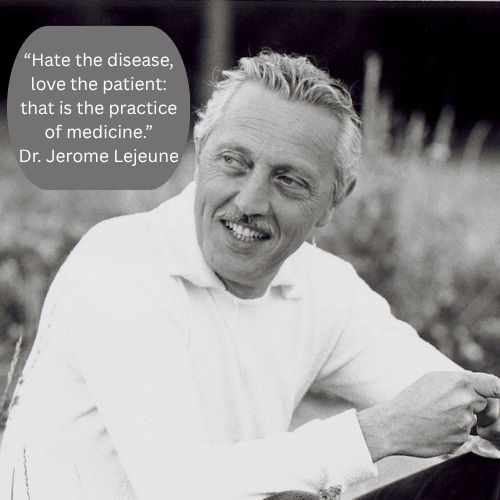
I first met Lejeune in 1986 in Brighton, England, when he spoke to an international assembly of parents and professionals at a symposium on Down syndrome. As a distinguished speaker on the topic of Down syndrome, Lejeune was invited to symposia all over the world. I was blessed to again meet with him at another conference on the same topic in Mexico City the following year.
Lejeune was gifted in that he could keep an audience of parents and professionals interested on all levels. He was comfortable speaking to both sets of people in the same audience. He respected all persons, whether they had degrees or had an extra chromosome.
The Dicovery
In 1958, the then-32-year-old was working in his laboratory with his colleague Marthe Gautier when he discovered what actually causes Down syndrome.
The human genome has 23 pairs of chromosomes – one set from the father and one set from the mother. Lejeune realized that having an extra chromosome on pair 21 upsets the natural working order of the other pairs.
This imbalance sets up certain differences in the physical, mental, and sociological development of a child. After studying many karyotypes, he additionally discovered this imbalance in chromosomes happened during development in the womb.
Lejeune published his findings in the French Academy of Sciences around May of 1958. Before this time, children with Down syndrome were only known by the general population as looking different and being slow learners.
There are three distinct groups of people with Down syndrome known to us today: the most common is known as Trisomy 21 (about 95% of the Down syndrome population); the second is commonly known as Translocation Down syndrome (about 3 to 4% of the Down syndrome population); and the third is called Mosaic Down syndrome (about 1 to 2% of the Down syndrome population). Lejeune described several other chromosomal abnormalities during his distinguished career.
Firebrand for Personhood
In a biography of Dr Lejeune written by his daughter, Clara Lejeune-Gaymard, titled Life is a Blessing, Lejeune-Gaymard wrote that her father “stubbornly refused to accept the logic and rewards of the Culture of Death.” He spoke out against many evils that stem from that worldview, such as abortion, artificial (in-vitro) fertilization, and pornography, even though these were illegal in most parts of the world in his day. His foresight makes him especially a pro-personhood hero for our times.
Indeed, after Lejeune’s discovery of the cause of Down syndrome, many people in the scientific and medical communities saw abortion as a way of “curing” this abnormality in the world, but not Lejeune! Until his death, he diligently searched for a way to treat Down syndrome.
He saw in these children the pure love and forgiveness each one exudes. In his treatment of the syndrome, he continually let it be known that these most vulnerable and innocent children had a calling higher than most of us will ever know, and his concern for these children was so passionate. As he often indicated, anyone who has ever known a child with Down syndrome has been blessed by our Creator with a gift not everyone gets to receive.
Faith and Family
At his roots, Lejeune was a family man. He married Birthe Bringsted in 1952 and had five children: Clara, Karin, Anouk, Thomas, and Damien. Lejeune was also a man of faith. He saw each of his patients as persons made in the image and likeness of God and treated them as such.
Lejeune died of lung cancer on April 3, 1994, in Paris. Many people thought he should have been nominated for the Nobel Prize, but, due to his continual arguments with his peers over his staunchly pro-life stance on abortion, no one in the scientific community at the time would nominate him for the prestigious award. Lejeune had calculated the costs. After giving a speech in America in 1971 against abortion, saying to the National Institute for Health, “you are turning your institute of health into an institute of death,” he wrote to his wife, “Today I lost my Nobel Prize.”
He was, however, nominated to a much higher honor. In 2021, Pope Francis named Lejeune a “Venerable” in the Catholic Church, starting him on the long journey to eventually being proclaimed a saint in the Catholic Church.
Jerome Lejeune was a great person who happened to be a medical doctor and a geneticist. Through his work and dedication to our children, he gave parents and children with Down syndrome a better place to bloom. Thank you, Dr. Lejeune, for all you did!
Sources:
- Article: Jérôme Lejeune lost the Nobel Prize for being pro-life
- CDC: Three Types of Down Syndrome
- Lejeune Foundation
- Life is a Blessing: A Biography of Jérôme Lejeune―Geneticist, Doctor, Father by Clara Lejeune-Gaymard
Frank Murphy
Guest Columnist
Former Executive Director of National Down Syndrome Congress (’91-’02)
Guest Columnist
Former Executive Director of National Down Syndrome Congress (’91-’02)