
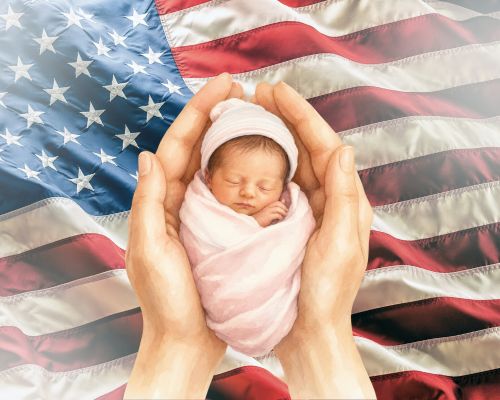
250 years ago this Independence Day, 56 brave Founding Fathers signed the Declaration of Independence to separate from England in favor of the preservation of their God-given rights: “We hold these truths to be self-evident, that all men are created equal, that they are endowed by their Creator with certain unalienable Rights, that among these are Life, Liberty and the pursuit of Happiness.”[1]
From the very founding of our nation, the paramount right to life has been extolled as an unalienable right from the Creator. And of course, this Creator was not a hyperbole or metaphor. All 56 signers of the Declaration were men with Christian principles.[2] Though some were more orthodox than others, all of them revered the Creator as the Christian God, whose Providence guided the nation they were founding.
And America has always been Christian, even before it was a nation; just look at the first words of the 1620 Mayflower Compact: “In the name of God, Amen.” The pilgrims sailed to the American continent “for the Glory of God, and Advancement of the Christian Faith.”[3]
Yes, America’s founding documents, historical court cases, and even its failings have highlighted the foundation of personhood in this Christian country.
Constitution
“We the People of the United States, in Order to form a more perfect Union, establish Justice, insure domestic Tranquility, provide for the common defence, promote the general Welfare, and secure the Blessings of Liberty to ourselves and our Posterity, do ordain and establish this Constitution for the United States of America.”[4]
Perhaps you memorized the above Preamble to the Constitution in school, or maybe even enjoyed jamming out to the Schoolhouse Rock rendition from the ‘70s. But have you ever really meditated on who “We the People” are? For whom is the Constitution written?
A big clue to answering this is the phrase “to ourselves and our Posterity.” This is no word salad like a modern politician might spout off; the Constitution went through nearly four months of drafting and revisions before being finalized, and every word counted.
The Founders did not intend these goods of the United States only for themselves. The general welfare, the blessings of liberty, etc. were intended equally for their posterity – their children and their children’s children and so on. Thus, we see a kernel of personhood right here; the right to have rights extended not just to the current generation but also to those yet to be born.
Supreme Court Cases
So far, you may feel like historical personhood seems abstract, but some key court cases from America’s history put the personhood of the preborn in clear perspective.
At least twice in America’s history, a case has made its way to the Supreme Court (SCOTUS) regarding inheritance rights of the preborn. In the 1884 case of McArthur v. Scott, SCOTUS ruled in favor of “The plaintiffs in the present case, being as yet unborn,” clearly recognizing the personhood of the preborn.[5]
Perhaps even more telling is the 1972 case of Weber v. Aetna Casualty & Surety Co. This case also revolved around inheritance and set the child born after the death of his father on equal footing with those already born at the time of the father’s death. While the deeper issue of the case focused on legitimate versus illegitimate children, it is key to note that the child who was preborn when his father died received the same rights as those already born.[6]
Note the year of the Weber case: 1972. Only a year before Roe v. Wade, the court was still ruling to protect rights of the preborn.
Modern Laws
Yes, it is hard to shake an almost-200-year tradition of protecting personhood for the preborn. Despite the pro-aborts’ attempts to wipe away these protections in the past 50 years, many laws in these post-Roe years still contradict the narrative that a preborn life is worth less than a born one.
For example, 39 states have fetal homicide laws. This means that if a person harms or kills a pregnant woman, he can be held accountable for the injury or death of two persons, not one. 31 of these states give full recognition to the preborn person who was harmed.[7]
Additionally, the federal Unborn Victims of Violence Act was passed in 2004, allowing preborn persons to be recognized as legal victims if injured or killed in federal crimes. The Act defines the unborn as “a member of the species Homo sapiens, at any stage of development, who is carried in the womb.” Sadly, there is a carveout in the Act that still allows for abortions.[8]
Slavery
Overall, America’s history is full of ideals of personhood, driven by Christian faith. Some may say that the US has not lived up to its ideals and would likely point to the fact that slaves in America were stripped of personhood. However, how this country reacted to its failings is telling.
In the Constitutional Convention itself, all but two states were willing to abolish slavery in the new law of the land, though those two eventually won out for unity’s sake. Nevertheless, all the states north of Maryland had abolished slavery by 1804.[9]
Additionally, do you know how many countries in the world have had leaders so passionately against slavery that they are willing to fight a war to end it? You guessed it: just the USA.[10] Remember, the Republican party was formed explicitly against slavery. Think about that: Americans were willing to fight against their countrymen and sometimes even their own family members to restore the God-given personhood to strangers whom many of them had never met.
And one cannot forget the Christian thread running through the personhood movement. During the Civil War, President Lincoln said, “If God now wills the removal of a great wrong, and wills also that we of the North as well as you of the South, shall pay fairly for our complicity in that wrong, impartial history will find therein new cause to attest and revere the justice and goodness of God.”[11]
Metanoia
And what now, America? Just under 100 years into our history as a nation, our forefathers were willing to fight to end a great affront against personhood. Now, we face an evil arguably worse than slavery: the legal murder of preborn American persons. At this 250th anniversary of our nation, will we take this time to have a national metanoia[12] to God, restoring personhood to the preborn as our ancestors did for the slaves?
Let us pray for America, and let us advocate for personhood always. Sign Georgia Right to Life’s Personhood Amendment Petition here.
Sources:
[1] Declaration of Independence
[2] Religious Views of Declaration Signers
[3] Mayflower Compact
[4] Constitution
[5] McArthur v. Scott; See also article on The Constitution and Personhood Jurisprudence
[6] Weber v. Aetna Casualty & Surety Co.; See also article on The Constitution and Personhood Jurisprudence
[7] Fetal Homicide Laws by State
[8] Unborn Victims of Violence Act of 2004
[9] Abolitionism in Europe and America
[10] What Schools Don’t Teach You About Slavery
[11] Abraham Lincoln Slavery Quotes
[12] A Biblical term that means repentance and returning to God; see Metanoia | Bible Hub
Rachel Krause
Georgia Right to Life
The Pulse Editor

Rachel Krause first became involved with GRTL as a high school student, during which time she competed in and ultimately won the 2016 Student Oratory Contest. She attended Franciscan University of Steubenville, majoring in English and Theology. With her strong background in communication, including working with the Image and Likeness magazine and the Quest Catholic radio, Rachel looks forward to continuing to share the pro-personhood message through the GRTL e-newsletter. Mrs. Krause lives in Duluth with her husband and two little boys.