

The Fashionable Thing to Do
Surrogacy is popular. Celebrities ranging from Kim Kardashian, Paris Hilton, and Chrissy Teigen have all utilized the process of surrogacy to create their children.[1] However, they are not the only ones. Surrogacy is also popularized as a way for LGBTQ couples to have children.[2]
As personhood advocates, shouldn’t we rejoice that more precious children have been born into the world? After all, every child is a gift from God.
While this popular practice allows couples to fulfill their own desires for children, surrogacy must nonetheless be examined in light of its effects on the children born via surrogacy as well as on the surrogates themselves.
A Primal Wound
In our rush to encourage childbirth, are we neglecting the experiences of the children born through surrogacy?
Jessica Kern, reflecting on the fact that she was born via surrogacy, comments that it caused her irreparable harm to know that she was essentially “a product [to serve her parents’] wants and needs.”[3]
Surrogacy creates a primal wound in children, who are either separated from the biological mother who carried and birthed them (traditional surrogacy where the surrogate’s egg and womb are both utilized to conceive a child), or separated from two women: the one who provided her eggs and the one who carried and birthed the child.
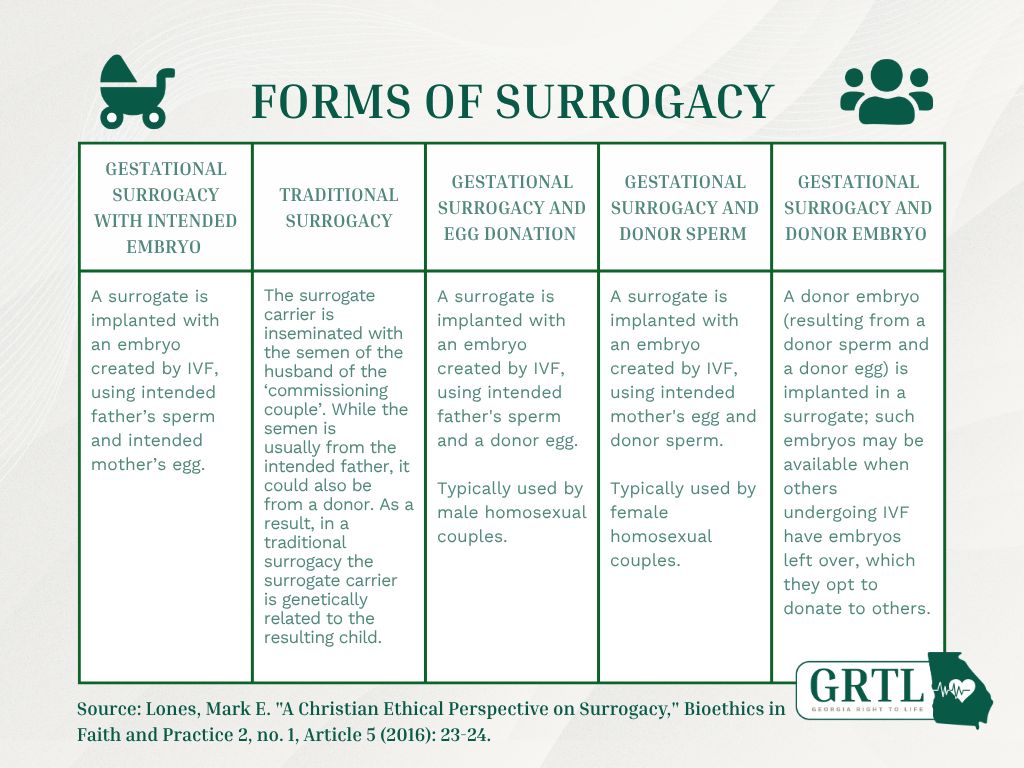
Separation of mother and child is extremely harmful. A study comparing the relationships between surrogate-born (traditional and gestational surrogacy both included), egg donation-born (children who were created with an egg “donated” from another woman, but not carried by a surrogate), and children conceived naturally and the adults raising them, demonstrated that while negative interactions are less frequent in younger ages, by ages six to seven, the level of mutuality, or the positive interactions between surrogate-born children and mothers, was lower than the naturally-conceived children.[4]
This discrepancy likely arises from six- to seven-year-olds trying to understand their origins while the mothers simultaneously wrestle with their decisions to utilize a surrogate and not being able to conceive naturally.[5] The study also pointed to the “factors associated with the absence of a genetic relationship may have a greater role to play in the less positive mother-child interaction than factors associated with the absence of a gestational bond.”[6]
Thus, the available research demonstrates the compounded ethical issues with how surrogacy can sever the genetic bond children long to have with their parents, whether through children having no knowledge of their biological mother, father, or both biological parents.
Many children intuitively understand who their biological mother is. A traditional surrogate in California—meaning she is genetically related to the children she carried—shared how her surrogate children intuitively know that she is their biological mother and not the intended parents.[7]
Popular commentator Trent Horn pointed out that (emphasis added):
…every language also has a word for mother, and almost all of them include the letter M and have a “mama” sound in it. That’s probably because ma sounds are the easiest for infants to say and they’re directed at the person who is ordered towards sustaining the child’s life, his mother. And so we should outlaw practices designed to destroy that sacred bond between mother and child.[8]
Child abuse is also rife in surrogacy “rings” which are completely unregulated in the United States. A case in point is from a couple in California, who founded their own surrogacy agency and “bought” the children created through these surrogacy contracts.[9] Ultimately, all 21 of these children were taken into the custody of the state due to abuse.[10]
Studies corroborate the point that children living in homes with unrelated adults are more likely to experience abuse than children living in homes with two biological parents.[11] And while some of these concerns may be raised for children in adoptive homes, it is worth noting that the intention is different: adoption is done for the good of the child, to remedy some bad situation, whereas surrogacy brings children into the world with the intention to separate them from the birth mother for the sake of the intended parents, not for the good of the child.
A Rented Womb
Sadly, the needs of surrogates are also simultaneously neglected. Whether the surrogate is a traditional surrogate or a gestational surrogate, she is commonly treated as a “breeder” for another family.
Surrogacy arrangements are typically treated as legal contracts. The needs of the women carrying the intended parents’ child are often neglected. A surrogate named Taylor Bland recounted how intended parents tried to force an induction on her and neglected her wishes for a natural birth.[12] The intended parents never checked on Bland to see if she needed help throughout her pregnancy, except to control her diet.[13]
In states where surrogacy has no regulations, such as California, pro-birth orders are typically signed. This is where the surrogate signs over any parental rights before the child is even born.[14] Abortion clauses are also commonly included in surrogacy arrangements.[15] The child born is then legally the “intended” parents’ and taken from the surrogate, at times moments after the child is born.
A recent surrogacy arrangement in Florida has led to Florida Attorney General James Uthmeier arguing that the practice itself is unconstitutional and against the 13th Amendment. After a French couple utilizing a surrogate in Florida obtained a “pro-birth” order, Uthmeier challenged the order when the child was born. He likened the surrogacy arrangement to slavery, where the child has been treated as contractual property.[16]
Surrogates also face larger health risks than non-surrogate women. In a study done by the Center for Bioethics and Culture, surrogate women surveyed had 17% of their pregnancies classified as pre-term, versus 1.4% of non-surrogate women.[17]
Their research concluded that, “Looking at specific complications between surrogate pregnancies and spontaneous pregnancies, there is a statistically significant difference in five of the conditions”: those being high blood pressure, hemorrhage, pre-term labor, post-partum depression, and post-partum high blood pressure.[18]
Is it worth the risk?
Given the immense struggles of surrogates, the disregard for the maternal bond between mother and child, and the inverting of God’s natural order, the practice should be made illegal in the United States. Children have a right to know who their mother and father are and not to be commodified as objects.
Georgia Right to Life advocates for the vulnerable and oppressed. It is time to advocate for the children and women exploited by surrogacy.
“Open your mouth for the mute,
for the rights of all who are destitute.”
Proverbs 31:8
Sources:
[1] Cosmopolitan Article
[2] Raising Buffaloes Video
[3] Jessica Kern Testimony
[4] Golombok, S., Readings, J., Blake, L., Casey, P., Marks, A., & Jadva, V. (2011). Families created through surrogacy: mother-child relationships and children’s psychological adjustment at age 7. Developmental psychology, 47(6), 1579–1588. https://doi.org/10.1037/a0025292
[5] Ibid.
[6] Ibid.
[7] Veronica Surrogacy Testimony
[8] Trent Horn Video on Surrogacy
[9] Arcadia Surrogacy Scandal
[10] Ibid.
[11] Schnitzer, P. G., & Ewigman, B. G. (2005). Child deaths resulting from inflicted injuries: household risk factors and perpetrator characteristics. Pediatrics, 116(5), e687–e693. https://doi.org/10.1542/peds.2005-0296
[12] Dark Side of Surrogacy
[13] Ibid.
14] California Surrogacy Law
[15] Abortion Clauses in Surrogacy Arrangements
[16] Miami Herald Article & Live Action Article
[17] Lahl, Jennifer; Fell, Kallie; Bassett, Kate; Broghammer, Frances H.; and Briggs, William M. (2022) “A Comparison of American Women’s Experiences with Both Gestational Surrogate Pregnancies and Spontaneous Pregnancies,” Dignity: A Journal of Analysis of Exploitation and Violence: Vol. 7: Iss. 3, Article 1. https://doi.org/10.23860/dignity.2022.07.03.01
[18] Ibid.

Georgia Right to Life – Project Coordinator